Maxim Kazakov
Software where biology meets computation.
I work in computational biology, building software focused on reproducible workflows with biomolecular models and autonomous AI agents within biology.
If you build within this field or are also interested, let's connect →Using biomolecular models to predict how proteins meet, and learning where those models stop being trustworthy.
Exploring the limitations of structure and co-folding models such as Boltz-2 and AlphaFold, and working around them: building statistical models and null decoys to distinguish genuine biological signal from what the model would say about anything.
Pose validation with PoseBusters, statistical methods for ranking and calibration, and contributions to methods from my side where the existing tools fall short.
A long-standing interest in Mycobacterium tuberculosis and Escherichia coli, and in how resistance emerges and spreads.
With Rok Krašovec at the University of Manchester I work on E. coli, searching its proteome for binding candidates that could matter for how the bacterium resists treatment.
"The world faces an antimicrobial research and development crisis, with few new medicines in the pipeline."
world health organization ↗
Software that can automate and assemble biomolecular tools into pipelines that run the same way twice.
I have contributed to this with my project BioSentinel. I want to build software that can automate and assemble biomolecular tools, and I have done that for antimicrobial resistance predictions.
I am interested in it as a software task in general: the orchestration, the provenance, and the tests that make a pipeline trustworthy, whatever the biology inside it.
Where I work, study, and research.
I am building BioSentinel to bring on-demand drug resistance predictions to labs and clinics and do research in antimicrobial resistance. I contribute to labs in Manchester and Massachusetts and run the Manchester Computational Biology Society.
Some of what I am building.
The intelligence layer for drug resistance. Predicts what mutations do to drugs, from bacteria to cancer, with no changes to existing code.
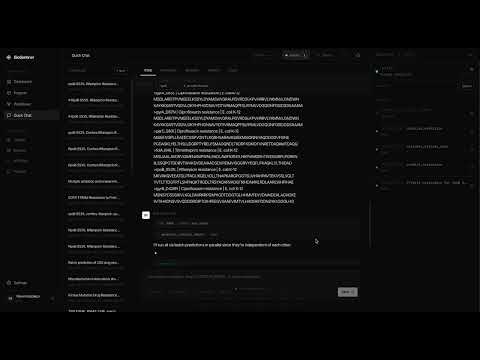 ▶ watch demo
Built a multiple-step pipeline that identified potential binding candidates within the E. coli proteome using Boltz-2. Awaiting wet lab validation and an upcoming paper.
Tested the efficacy of biomolecular models in existing prediction architectures. Awaiting publication of results.
Built in a weekend.
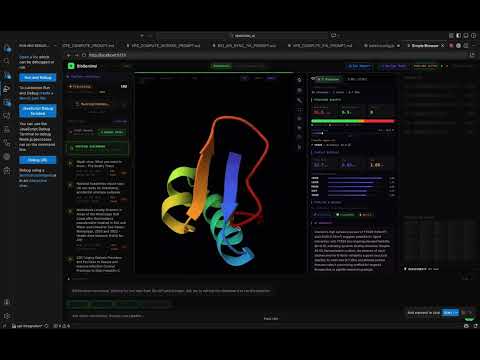 ▶ watch demo
An earlier take on what became BioSentinel: a biology interface for autonomous agents, built and demoed over one hackathon.
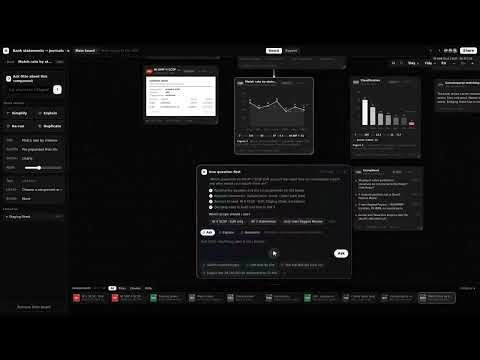 ▶ watch demo
A Canva/Notion for accounting. Every figure traced back to the query that produced it, so the numbers foot before anyone reads them.